
Portfolio and acquisition reviews
Recurring review
The same file at two committee meetings
Previous meeting
A milestone confirmation was missing. The review note recorded the open question and its owner.
Next meeting
Has the record arrived? The committee receives the new source and its scope, or the outstanding question with an owner and a due date.
Reopening the same question does not count as another completed review.
Illustrative model
When does review time cover modelled costs?
At 100%, the value of review time available for other work equals the modelled costs to date. This is not a measured cash saving.
Assumptions revised · 10 November 2026
Cumulative value of reusable review time ÷ modelled costs to date
- Less follow-up work
- Unchanged follow-up work
- More follow-up work
- 100% · Costs covered
See values and assumptions
Time value first covers costs at the close of month 2 with less follow-up work and month 4 with unchanged follow-up work. The third curve stays below 100% even if the model is extended.
| Follow-up work | 0 | 1 | 2 | 4 | 6 | 12 |
|---|---|---|---|---|---|---|
| Less follow-up work | 0% | 80% | 112% | 140% | 153% | 168% |
| Unchanged follow-up work | 0% | 57% | 80% | 100% | 109% | 120% |
| More follow-up work | 0% | 34% | 48% | 60% | 65% | 72% |
One completed file review, with the same scope and quality. Count active minutes across all participants. Measure calendar waiting time separately. The October assumptions are 75 versus 45 minutes and 80% reusable time.
For 30% of files, exceptional follow-up changes from 60 to 20 minutes, or the reverse. Counted once, this gives ±12 minutes on average. The three gross differences are 42, 30 and 18 minutes per review.
Volume is constant from the start. Setup costs four thirds of one month’s operating cost. The homepage uses 100 units for total modelled costs at month 12. With less follow-up work, the value of time freed up reaches 168 units by then. The three lines here compare time value with costs to date at each month. The three-year model in The Brief uses a separate ramp-up.
Acquisition of a completed building
Fischamend, Austria
Historical image comparison · Sentinel-2
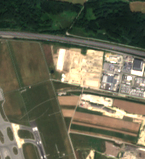
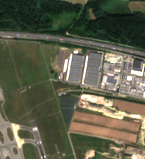
Contains modified Copernicus Sentinel data 2023 and 2025. Public COG mirror: AWS Registry of Open Data / Earth Search. Sentinel-2 COGs ↗
Two large roof areas are visible in the later image.
Question for the seller
If the seller supplies a handover record, which hall and stage of work does it cover?
The images alone cannot answer that question. The buyer and the question are illustrative. The comparison does not establish handover or the building’s condition today.
Review a financing, refinancing or drawdown
Financing or refinancing
Which condition must be evidenced before approval? Match the record and its date to the condition for this loan.
Drawdown
Which record supports the condition for the next drawdown? Match the evidence to the milestone and tranche.
Follow collateral over time →We are developing Elmar for authorised reviewers using Construction Risk Intelligence. It is designed to flag missing or conflicting records, point to the source and suggest the next question.